

VERMEER – Master of Light
English translations
Contents
Summary of the German spoken text

At its heart, this is a story about light, color, and the quiet moments that defined Johannes Vermeer's artistic vision. The artist was perpetually fascinated by the fundamental question: "Can I paint light?" This quest to capture the ethereal quality of illumination would become his lifelong pursuit.
In his studio, Vermeer was a meticulous craftsman of color. He created his pigments with extraordinary care - grinding precious lapis lazuli to create the brightest blue ultramarin, extracting red from the madder plant, and burning yellow earth to achieve deeper tones. He would press pigments with all his body's weight, letting the powder run through his fingers to test its fineness, washing away chalk, sand, and gravel until he achieved the perfect consistency. "My paintings are children of the colors I create," he would say.

The artist had a particular genius for teaching others to truly see. In one telling scene, he asks his model (the girl with the pearl earring) to look at clouds and describe their color. When she initially says "white," he pushes her to look more carefully until she discovers the blues, yellows, and even greens hidden in what she had always assumed were simply white clouds. This exemplifies Vermeer's gift for observing the subtle complexities in seemingly simple scenes.
Vermeer was especially drawn to depicting women in their private moments. He saw them as inhabiting their own universe, full of modest pleasures, quiet passions, and intimate secrets. Rather than trying to fully understand this world, he positioned himself as a respectful observer, capturing moments of letter-writing, music-making, and domestic tasks with extraordinary sensitivity.
Music played a crucial role in his work. "Without realizing it, I have painted music," he once reflected. Many of his paintings feature musical instruments - virginals, lutes, flutes - not just as objects but as symbols of harmony and cultural sophistication.
To aid his remarkable vision, Vermeer likely used a camera obscura, which he described as an instrument that helped him "see differently, see more than what is there." When light entered through a single point into this device, it projected an inverted image that allowed him to study details he might otherwise miss.
Throughout his life, Vermeer sought silence and contemplation. "Silence tells me I'm not alone... it speaks to me!" he would say. In his quiet studio, away from the bustle of daily life, he created works that captured not just visual reality but moments of deep psychological truth.
Perhaps most movingly, Vermeer understood the temporal nature of his art. He recognized that he existed in his time while viewers would exist in theirs, yet through his paintings, these moments would connect across centuries. His work became a bridge between past and present, capturing what he called "the moment" - that liminal space where past flows into future, and where artist and viewer can meet across time.
This deep philosophical understanding, combined with his technical mastery and keen observation of daily life, helped create the timeless quality that makes Vermeer's work so compelling even today.

The Life of Vermeer
JAN VERMEER VAN DELFT (1632-1675)

Joannis van der Meer, also known as Jan Vermeer, stands as a singular figure of the Dutch Golden Age, distinguished from his contemporaries by his extraordinary technique and distinctive artistic vision.
Though his body of work comprises of just 36 paintings, Vermeer's contribution to art history remains profound. His innovative approach to light and color earned him recognition as the Master of Light, while his works continue to intrigue scholars until today. His technical precision, use of precious pigments to create distinctive color palettes, and geometric mastery of perspective all work in concert to create an intimate dialogue with viewers that transcends time and culture.
While his exact birth date remains unknown, records show his baptism on October 31, 1632. Though christened Joannis - the Latin form of Jan - he never used this name. His family background presents a colorful tapestry: his maternal grandfather was a known forger, while his paternal grandmother, a dealer in second-hand goods, declared bankruptcy three times. His uncle, a military man, tarnished the family reputation further by squandering civic funds and landing in prison. Vermeer also had a brother, Geertruy, who worked as a stonemason in the Dutch East Indies.
His father, Reynier Janzoon Vermeer, proved the most influential figure in his early life. A weaver of fine cloths and art dealer, Reynier opened an inn in central Delft after marrying Digna Balthens in 1615 to support his family.

The historical record falls silent regarding Vermeer's early years until 1653, when he became engaged to Catharina Bolnes. Their marriage on April 20, 1653, in a modest ceremony south of Delft, required Vermeer's conversion to Catholicism - his bride's family being wealthy Catholics. Catharina's mother Maria initially opposed the match, concerned about both the Protestant faith and lower social standing of Vermeer's family. The couple would have fifteen children, though four died in infancy.
Financial struggles marked their early married years, forcing them to live with Catharina's mother. Even after joining Delft's Guild of St. Luke as a master painter, Vermeer's financial difficulties continued, requiring a loan from his mother-in-law to complete his training. While the identity of Vermeer's artistic teachers remains uncertain, some sources suggest influence from one of Rembrandt's pupils.
By 1662, Vermeer's prominence in Delft grew as he became dean of the Guild. His paintings, rarely available on the open market, commanded impressive prices from patrons and collectors who often held rights of first refusal. Following his father's path, he also worked as an art dealer, though this venture proved less successful.
The French invasion of 1672 brought financial ruin to Vermeer's business, cutting him off from European trade. He died just three years later at age 43 after a brief illness, and was laid to rest in Catharina's family tomb in Delft's Oude Kerk on December 15, 1675.
Vermeer left behind eleven children - eight minors, two seriously ill, and one injured in a gunpowder accident. His studio contained just two of his own paintings ("Lady with a Pearl Necklace" and "Mistress and Maid") along with twenty-six works by other artists, which sold for 500 Dutch guilders to offset his debts.
Catharina inherited items of modest value, including some paintings and a yellow fur-trimmed jacket visible in many of his works. Unable to settle the debts, she petitioned The Hague court in 1676 to delay creditor payments. In 1677, twenty-six remaining works were auctioned, some held by the Guild. After her mother's death in 1680, Catharina sought refuge in an orphanage, where she died shortly after at age fifty-six, leaving her children to a guardian's care.
Twenty of Vermeer's paintings later sold for 1,503 Dutch guilders, apparently without authentication, as no catalog of his works existed until the mid-20th century. His paintings vanished from historical record until the late 19th century, when scholarly interest revived his legacy through publications and essays.
Today, Vermeer stands among art history's supreme masters, pioneering in his treatment of light. His "Girl with a Pearl Earring" remains one of the world's treasured masterpieces, embodying his unique ability to capture moments of profound intimacy and stillness.

The Immersive Experience
For the first time, an immersive art experience presents the complete works of one of the Netherlands' most significant artists, Jan Vermeer, in a groundbreaking format.
Through Vermeer's evocative paintings, this exhibition takes visitors on a journey through four distinct spaces, telling the story of the Netherlands and life in this seafaring nation. In the 17th century, the Dutch Republic emerged as a global power, leading the world in painting, science, and commerce, its prosperity evident in every aspect of society.
Part One
Visitors experience an emotional immersion into Vermeer's world through two masterpieces: "View of Delft" and "The Little Street." The experience guides us through Vermeer's microscopic attention to detail, allowing viewers to enter the paintings themselves, soaring over 17th-century Delft until reaching the house where Vermeer maintained his studio.
Through innovative technology and live-action footage, ten of Vermeer's paintings come to life, each telling its own story.
Part Two
The exhibition explores Vermeer's ten portraits of young women, which reveal his profound appreciation for the feminine. This section is enhanced by dance choreography that serves as an artistic ally to the women's emotional states portrayed in the paintings.
Part Three
Seven paintings depicting young women playing musical instruments are brought to life through visual effects and musical accompaniment, creating a multi-sensory experience that bridges the centuries.
Part Four
Six additional paintings addressing themes of faith and the universe are presented in an experiential format that invites deep engagement with these profound works.
As the author develops these four parts, he poses a question: How can one tell a story about Vermeer without precise documentation and still convey a faithful and honest view to the visitor?
The only answer stands clear: One cannot! The author acknowledges this impossibility and resolves it through a creative solution - letting the artwork speak for itself!
Vermeer's works form the soul of this production! Throughout these four parts, large-scale projection reveals the unique eye for detail in Vermeer's predominantly small-format paintings. Everyday moments, gleaming fabrics, shadows, or even a letter the table come alive as paintings surround the viewer. Vermeer transforms the ordinary into the extraordinary.
Through seemingly unremarkable domestic scenes, the painter captures our attention in an incomparable way and gives us intimate insights into life more than 350 years ago."

Historical Context
Vermeer lived during the Dutch Golden Age - an extraordinary period when the Dutch Republic flourished through unprecedented economic prosperity, cultural innovation, and scientific achievement, while dominating international trade and commerce.
The Dutch Golden Age spanned from the Republic's founding in 1588 until 1672, the notorious Rampjaar (Disaster Year), fundamentally shaping both Dutch history and the nation's global influence. During this period, the Dutch East and West India Companies established hegemony over trade routes, maintaining strongholds and colonies across the Americas, southern Africa, and Asia. This commercial empire facilitated access to precious commodities, generating national wealth and fostering the rise of a prosperous middle class.
Vermeer's paintings often incorporate precise cartographic elements that serve both aesthetic and symbolic purposes. These maps and globes in his work reflect a society deeply engaged with the world beyond its borders. They also highlight the significance of Dutch cartographic production - an enterprise that shaped not only the period's physical landscape but also the intellectual and artistic currents defining the Golden Age.
Dutch cartography during this era was more than navigational utility, enabled by the economic might and research capabilities of the trading companies. It mirrored the cultural aspirations of a nation at the forefront of global exploration. This cartographic tradition laid foundations that would influence generations of mapmakers and transform how we perceived the world.
In Vermeer's work, we see these broader cultural and economic forces refracted through the lens of domestic life. His paintings, with their careful attention to maps, global trade goods, and the material culture of a prosperous society, offer us intimate glimpses into everyday life during the Dutch Golden Age.
Art Style Vermeer

COLOR
Color stands as the cornerstone of Vermeer's artistry. He crafted his oil colors using premium raw materials to achieve vibrant, luminous hues, frequently employing pure pigments - a choice that explains why his paintings maintain their remarkable vibrancy centuries later. His color-making process involved grinding raw pigments and combining them with oil to create paint. Microscopic analysis has revealed that Vermeer deliberately varied his paint consistency, from coarse to refined, to enhance spatial depth in his compositions. Intriguingly he often applied coarser-grained pigments in the underlayer specifically in areas where he wanted to emphasize light, thereby achieving more dramatic contrasts between light and shadow.
STYLE
Vermeer's distinctive technique can be characterized as "pointillé," featuring minute, closely-spaced brushstrokes that create a seamless surface where colors appear almost translucent. His approach to preliminary sketching was notably flexible. In some paintings, researchers have discovered light brown preliminary drawings that went beyond simple outlines, serving instead as groundwork for his masterful treatment of light and shadow. These delicate lines were subsequently concealed beneath layers of oil paint. In other works, there is no evidence of preliminary drawing at all. Vermeer created his paintings over multiple layers, often applying darker tones first, followed by lighter colors to achieve his signature luminous effects and chiaroscuro.
SUBJECTS
Vermeer's body of work consists primarily of portraits, with young women and girls as his principal subjects. These figures span the social spectrum of Dutch society - from elegant ladies to humble maids - typically portrayed within bourgeois interiors, believed to be his own studio. These subjects are captured in ordinary moments of daily life, yet Vermeer's meticulous attention to detail and masterful technique elevates these scenes from the mundane to the extraordinary. Through his artistic vision, he bestows a sense of dignity and beauty upon these intimate moments, creating an atmosphere of tranquility and contemplation that has captivated viewers.

Scenes and their Execution
Vermeer crafted each scene with exquisite attention to detail, carefully studying every aspect before putting brush to canvas. His masterful rendering of draped garments and textiles - from curtains to tablecloths - enriches his paintings, lending them warmth, movement, and depth while creating subtle interplays of light and shadow.
Perspectives
Vermeer's compositions follow rigorous organizational principles, with meticulous attention to perspective. This is demonstrated in the perfect proportions of objects, which exist in careful equilibrium with their surrounding space, imbuing each work with a profound sense of tranquility and harmony - not unlike a photograph. Likely influenced by the camera obscura, Vermeer achieved precise framing and focusing in his works. He even mastered a "selective blur effect," creating the impression of viewing the painting through a camera lens, thereby achieving a remarkably faithful representation of reality.
LIGHT
Vermeer's command of light stands as one of his most extraordinary achievements. In his paintings, light - typically depicted streaming through windows - serves far beyond mere illumination. It becomes a vital element that shapes the very mood and atmosphere of his works. With painstaking precision, he studied how natural light behaved as it fell upon his subjects, using this understanding to create profound sensations of depth and warmth.
Light in Vermeer's works interacts distinctively with each surface it touches - figures, objects, and fabrics all reflect it according to their material nature and color. In some remarkable instances, he even captured the very presence of humidity in the air. Through this masterful handling of light, Vermeer created an intricate dance between illumination and shadow that breathes life into his paintings. The effect is not simply technical brilliance, but rather a deeper truth about how light reveals the essence of the visible world.
This treatment of light transformed seemingly modest domestic scenes into moments of transcendent beauty, where even the simplest household item could become radiant with significance under his brush.
Vermeer was posthumously titled the "Master of Light”.

Curiosity
The Evolution of Vermeer’s Signature
Among all of Vermeer's paintings, only 25 bear his signature. The visibility of these signatures varies considerably depending on the preserved state of each work. In some cases, the signature is barely perceptible, while in others, it is thoughtfully positioned to enhance the painting's aesthetic composition. Over the years, Vermeer's signature evolved through four distinct variations:
- His earliest signature begins with an 'I' (representing 'Johannes'), followed by a dot. To the right, a leftward-facing signature creates a 'V' at the left base of the 'M'; these letters interweave and conclude with 'eer' in italic script.
- The second type features a monogram in capital letters, followed by 'eer' in italics. The monogram ingeniously combines multiple elements: an 'M' intersected by a 'V' at the base of its left line, while a dot above this same line forms the 'J' (for 'Johannes').
- The third variant evokes Roman lettering. Here, the 'I' (for 'Johannes') is positioned within the center of the 'M', which simultaneously forms the 'V'. The signature concludes with 'eer' in italics, featuring the distinctive flourish of the 'r' characteristic of "cursive humanist" style.
- His final signature style consists of a simple 'I' with a dot, followed by 'Ver' and 'Meer' separated by a hyphen. In this version, both 'er' and 'eer' maintain their italic form, with the 'r' retaining its characteristic flourish.
This evolution in Vermeer's signature offers fascinating insights into his artistic development and the 17th-century Dutch practice of artistic identification.

Color Installation Panels
Let's Paint a Colorful Story: A Fun Painting Guide
Now it's your turn to create! Here's what you'll need:
- Canvas
- Pigment cups
- Brush
- Dropper
- Spoon
- Mixing cup
STEP 1
Find yourself a cozy spot with a canvas, bring along a brush (and maybe a paper towel for any artistic accidents!)
STEP 2
Grab your spoon (1g) and sprinkle some pigment into your mixing cup – here’s where the magic begins!
STEP 3
Take your dropper and add a few drops of water to your cup – watch the colors come alive!
STEP 4
Mix, mix, and mix some more! Keep stirring until your colors dance together!
STEP 5
Now you're ready to paint your masterpiece! Let your creativity flow!


Description of Paintings

"Christ in the House of Martha and Mary" (c. 1654-55)
This rare religious work from Vermeer's early period shows strong Caravaggisti influences in its dramatic contrasts and monumental figures. Christ's authoritative gesture toward Martha, while Mary sits attentively, demonstrates Vermeer's emerging genius for capturing profound moments, with domestic details foreshadowing his later focus.

"Diana and her Nymphs" (c. 1653-1654)
One of Vermeer's earliest works depicts the goddess and her companions in a woodland setting, showing strong Italian and Utrecht school influences through its dramatic light-dark contrasts. The luminous treatment of Diana's white dress against the dark background reveals Vermeer experimenting with the light effects that would define his later work, while this rare mythological subject marks an intriguing starting point before his shift to domestic scenes.

"The Procuress" (1656)
is one of Vermeer's earliest surviving works and stands apart from his later domestic scenes with its bold, almost theatrical depiction of a brothel scene featuring four figures engaged in a morally questionable transaction. The painting demonstrates Vermeer's early influences from the Utrecht Caravaggisti, particularly in its dramatic lighting and the coarse subject matter, showing a procuress (madam) accepting payment while a man in a flamboyant red outfit gropes a young woman in a yellow dress. The color palette is rich and striking - particularly the bold reds, yellows, and deep blacks - quite different from the pearlescent tones and subtle blues that would characterize his mature work. The artist included what many believe to be a self-portrait as the leftmost figure, smiling out at the viewer, making this one of only two paintings where Vermeer may have depicted himself. Unlike his later works which often suggest narrative through subtle gestures and glances, this painting is overtly dramatic and morally didactic, serving as both entertainment and warning about the dangers of vice - a common theme in Dutch Golden Age genre scenes.

"A Maid Asleep" (c. 1656-1657)
A young maid dozes at a table scattered with the remains of a meal, her face softly illuminated in Vermeer's signature light streaming from the left. The empty wine glass and jumbled tablecloth suggest moral commentary about sloth, while the glimpse of another room through an open door demonstrates Vermeer's early mastery of complex spatial relationships and his emerging interest in domestic narratives.

"Officer and Laughing Girl" (c. 1657)
A soldier in a dramatic red uniform sits in shadow with his back to us, while sunlight from a window bathes a laughing young woman in radiant light, demonstrating Vermeer's revolutionary understanding of perspective and illumination. The map on the wall, a recurring motif in Vermeer's work, combines with the soldier's presence to suggest both Dutch global reach and the intimate domestic impact of military life, while his masterful handling of the girl's yellow costume and luminous face shows his emerging genius for capturing fleeting emotional moments.

"Girl Reading a Letter at an Open Window" (c. 1657-1658):
A young woman stands in front of a window, absorbed in reading a letter, while Vermeer's masterful handling of light illuminates her face and yellow jacket against the recently restored background featuring a Cupid painting. The careful arrangement of domestic elements - from the green curtain to the bowl of fruit - transforms this private moment into a profound meditation on love and contemplation.

"The Milkmaid" (c. 1658-1659):
A kitchen maid pours milk from an earthenware jug, captured in a moment where Vermeer elevates humble domestic work to near-religious dignity through his masterful use of light. The meticulous detail - from the translucent stream of milk to the sun-catching bread crumbs and nail holes in the wall - demonstrates not only his technical virtuosity but his ability to find profound meaning in everyday moments.

"View of Delft" (c. 1660-1661)
This remarkable cityscape showcases Delft's harbor and architecture beneath a dramatic Dutch sky, with Vermeer capturing subtle effects of light and reflection in the water that were entirely new for landscape painting of the period. His intricate handling of light breaking through clouds to illuminate specific buildings - particularly the New Church's tower - combined with his masterful depiction of the city's mirrored image in the foreground water, creates what many consider the most extraordinary cityscape of the Dutch Golden Age.

"View of Houses in Delft" (c. 1658-1659):
Also known as 'The Little Street', this intimate cityscape shows a quiet corner of Delft with particular attention to the texture of brick, weathered walls, and daily life unfolding in doorways. Vermeer transforms humble domestic architecture into poetry through his precise observation of light effects on varied surfaces and his careful balance of geometric forms with human presence, while wooden shutters, washing lines, and women at their tasks create a masterful documentation of 17th-century Dutch urban life.

"The Glass of Wine" (c. 1659-1661)
In this complex domestic scene, a gentleman offers wine to a lady while another figure is visible through an open window, creating layers of social and moral commentary typical of Dutch genre painting. Vermeer's technical brilliance shines in the rendering of multiple light sources, the detail of the stained glass window, and the subtle reflective surfaces of glass, satin, and ceramic, while his psychological insight captures a charged moment of courtship.

"Girl Interrupted at her Music" (c. 1659-1661)
This intimate scene captures a young woman at a virginal, interrupted by a male companion, with Vermeer using the tension of the moment to explore both social dynamics and artistic virtuosity. His mastery shines in the complex play of light across multiple surfaces - from the sheen of silk to the gleam of marble floor tiles - while the partially visible map and empty chair create deeper spatial complexity and symbolism common in Dutch genre paintings, suggesting themes of harmony, interruption, and perhaps courtship.

"Young Woman with a Water Pitcher" (c. 1662-1664)
This masterpiece shows a woman in private contemplation beside a window, her hand resting on a silver pitcher as morning light transforms the scene into a meditation on domestic sanctity. Vermeer's virtuosity appears in multiple elements: the intricate lead-glass window design, the interplay of light on the woman's blue jacket and white head covering, the subtle reflections in the silver basin, and the rich textures of the oriental carpet - all working together to elevate a simple moment into something profound.

"Girl with a Wine Glass" (c. 1659-1661)
This complex scene depicts a young woman in red holding a wine glass, caught between two men in a richly furnished interior, creating a morally ambiguous narrative typical of Dutch genre painting. Vermeer's genius emerges in his handling of multiple light sources reflecting off the girl's satin dress, the wine glass, and the dimly lit background figures, while architectural elements and furnishings showcase his mastery of perspective and spatial relationships.

"Woman in Blue Reading a Letter" (c. 1662-1664)
This painting captures a woman in an intimate moment of complete absorption, her pregnant form emphasized by her blue morning jacket as she intently reads her letter. Vermeer's mastery of light creates an almost spiritual atmosphere through his handling of the window's illumination, while the empty chair and map on the wall add spatial depth and suggest connections to the wider world beyond this private moment.

"The Music Lesson" (c. 1662-1665)
In this complex interior, a young woman stands at a virginal with her back to us while her male teacher observes, their gazes meeting in the mirror above - creating a masterpiece of psychological and spatial complexity. Vermeer's virtuosity appears in multiple elements: the intricate perspective of the marble floor tiles, the subtle reflections in the mirror, the interaction of light with diverse surfaces, and the precise rendering of instruments, all working to create layers of meaning about music, harmony, and social relationships.

"Young Woman with a Lute" (c. 1662-1663)
This intimate scene shows a woman illuminated near a window, tuning her lute while apparently awaiting someone, creating an atmosphere of anticipation and musical preparation. Vermeer's genius emerges in the extraordinary treatment of light as it plays across multiple surfaces - from the luminous pearls in her hair to the soft sheen of her yellow and ermine-trimmed jacket, while the large map on the wall and emptiness of the room add both spatial depth and emotional resonance.

"The Concert" (c. 1662-1664)
This tragically stolen masterpiece (taken from the Isabella Stewart Gardner Museum in 1990) depicts three musicians in a richly appointed interior, exemplifying Vermeer's genius for complex group composition and symbolic meaning. His mastery shows in the interplay of light across varied surfaces - from the harpsichord's gleaming wood to the satin dresses of the performers - while the paintings-within-the-painting and careful arrangement of figures create layers of meaning about harmony, both musical and social.

"Woman with a Pearl Necklace" (c. 1662-1664)
A young woman stands before a mirror fastening her necklace, caught in a moment of self-contemplation that Vermeer transforms through his masterful manipulation of light. The scene demonstrates his technical virtuosity through the subtle reflection of window light on the wall, the gleam of pearls, and the rich yellow of her fur-trimmed jacket, while the empty chair and table with mirror create a composition that turns a private moment into a meditation on vanity and self-awareness.

"Woman Holding a Balance" (c. 1662-1664)
A young woman holds empty gold scales in divine light streaming from a window, while behind her a painting of the Last Judgment creates profound symbolism about earthly and spiritual measurement. Vermeer's mastery shows in the extraordinary handling of light on multiple surfaces - from the woman's soft headscarf to the gleaming pearls and gold on the table - while the perfect compositional balance and religious imagery transform this domestic scene into a meditation on morality and judgment.

"Mistress and Maid" (c. 1666-1667)
A well-dressed woman in a luminous yellow jacket sits at a table while her maid presents her with a letter, creating a moment charged with psychological tension about its contents. Vermeer transforms this domestic interaction through his virtuosic handling of light, texture, and symbolic objects - including pearls, writing implements, and a jewelry box - while the careful composition suggests both social hierarchy and shared human curiosity.

"A Lady Writing" (c. 1664-1667)
In this intimate scene, a woman in a luminous yellow jacket with fur trim pauses in her letter writing, turning to engage the viewer directly with an enigmatic gaze - one of the rare instances in Vermeer's work of such direct viewer engagement. His technical mastery is evident in the extraordinary rendering of light effects: from the soft glow on pearls (both worn and scattered on the table) to the subtle shadows cast by the writing implements, while the composition's careful balance turns a simple act of writing into a meditation on creativity and self-expression.

"Girl with a Flute" (c. 1664-1667)
This small work, whose attribution to Vermeer is debated by scholars, shows a young woman holding a recorder while wearing an exotic feathered hat, painted in a style that appears less refined than Vermeer's typical technique. The painting displays interesting elements of his usual approach - the play of light on varied surfaces, the direct gaze of the subject, the exotic costume - but the somewhat coarser execution of details, particularly in the face modeling and color handling, has led to ongoing discussions about whether it's by Vermeer or a close follower.

"Girl with a Red Hat" (c. 1664-1667)
A young woman gazes at us in dramatic three-quarter view, her face illuminated beneath a theatrical red hat, while Vermeer's virtuosity appears in the extraordinary rendering of light on multiple surfaces - from the gleaming lion-head chair finials to the reflections in her pearl earring. The painting showcases his mastery of glazing techniques in the vibrant red hat and blue tapestry backdrop, while the intimate scale and direct gaze create an immediacy unique in his work.

"Girl with a Pearl Earring" (c. 1664-1667)
A young woman glances over her shoulder, her face luminously rendered against a dark background, while her enigmatic expression captivates viewers across centuries. The painting's focal point - the gleaming pearl earring and exotic turban - exemplifies Dutch fascination with Eastern culture, while Vermeer's masterful handling of light creates an intimacy that earned it the nickname "the Mona Lisa of the North."
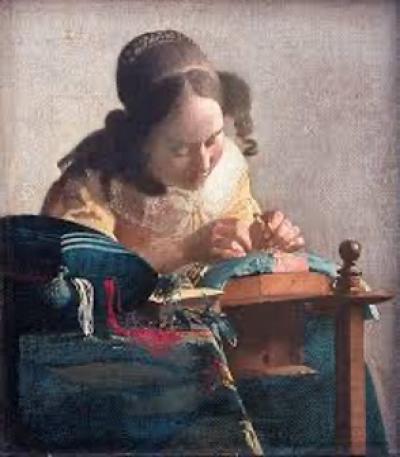
"The Lacemaker" (c. 1666-1668)
This small masterpiece, Vermeer's most intimate in scale, shows a young woman completely absorbed in the delicate work of lacemaking, her downward concentrated gaze matched by extraordinary technical precision. Vermeer's genius is revealed in his revolutionary handling of color and focus - the red and white threads in the foreground deliberately blurred while the yellow thread and her fingertips are rendered with pristine clarity - creating one of art history's earliest experiments with selective focus.
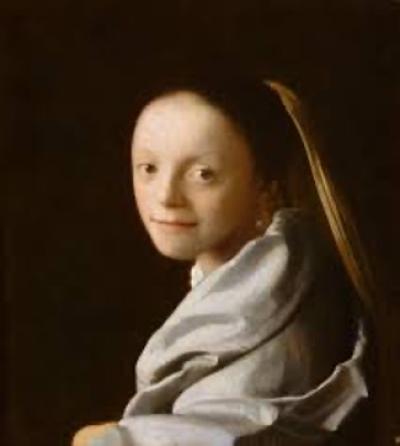
"Study of a Young Woman" also known as “Girl with a Veil” (c. 1664-1667):
This remarkable portrait-like study shows a young woman in exotic dress gazing directly at the viewer, her face turned in the characteristic three-quarter view Vermeer favored. His technical brilliance appears in the extraordinary handling of light on the pearl earring, white collar, and yellow jacket, while the direct gaze and slightly parted lips create an unusually immediate presence for a Vermeer figure.
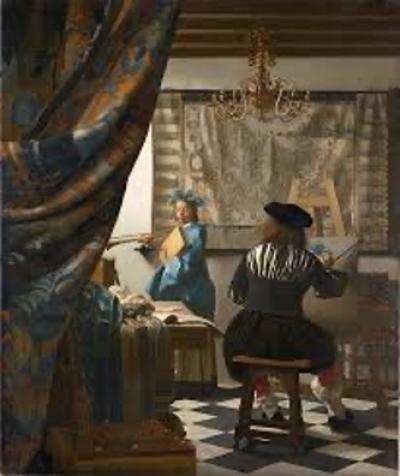
"The Art of Painting" (c. 1666-1668)
This monumental masterpiece, which Vermeer kept until his death, shows an artist painting Clio, the muse of history, in a richly appointed studio - creating a complex allegory about painting's nobility. The scene demonstrates unprecedented technical virtuosity: from the massive silk curtain drawn aside, to the intricate chandelier, the carefully laid marble floor, and the large map of the Netherlands, while the painter's rich costume suggests Vermeer's aspirations for his profession's status. The careful arrangement of light, perspective, and symbolic elements (including the mask of fame and the Habsburg eagle) creates a profound statement about art's relationship to history and truth.
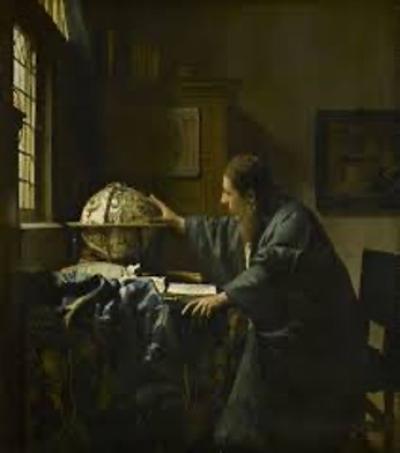
"The Astronomer" (1668):
A scholar bends over celestial instruments and Metius's astronomy book, bathed in symbolic light streaming through leaded windows. The rich blue robe and precise rendering of scientific instruments, including Hondius's globe, reflect both Dutch prosperity and the period's scientific revolution, while Vermeer's layered technique creates a luminous meditation on scholarly pursuit.
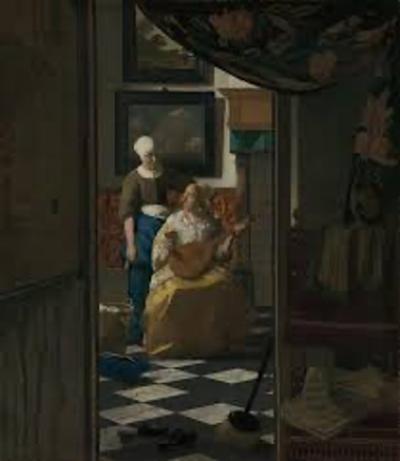
"The Love Letter" (c. 1669-1670)
This complex composition shows a maid delivering a letter to her mistress through a doorkijkje (view through doorways), creating Vermeer's characteristic 'picture within a picture' effect. His technical brilliance appears in the handling of multiple light sources, the intricate rendering of the marble floor tiles, and the subtle psychological interaction between the two women, while the background paintings of landscapes suggest themes about the distance between lovers.
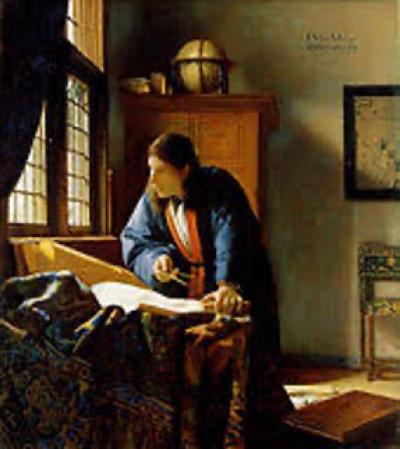
"The Geographer" (1669):
A scholar pauses in mid-thought, illuminated by Vermeer's signature window light, surrounded by meticulously rendered scientific instruments that reflect Dutch maritime supremacy. The dynamic pose and thoughtful expression capture the actual process of scientific thinking, making this both an artistic masterpiece and historical document.
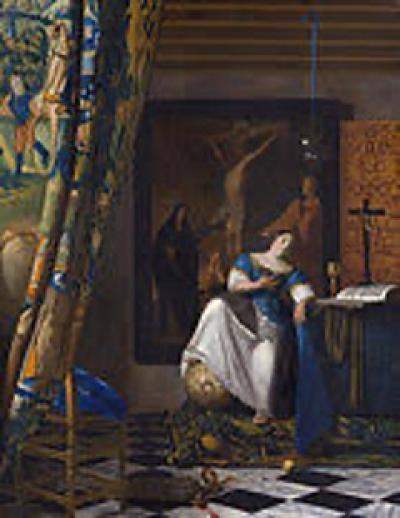
"Allegory of the Catholic Faith" (c. 1670-1672):
This unusually explicit religious allegory shows a woman representing Faith surrounded by complex Catholic symbolism - from the apple of original sin to the crucifix she contemplates. Vermeer's technical mastery appears in multiple elements: the gleaming marble floor, the interplay of light on the woman's satin dress, and the richly painted curtain, while the globe, glass sphere, and painting-within-painting of the Crucifixion create layers of symbolic meaning about earthly and spiritual vision.
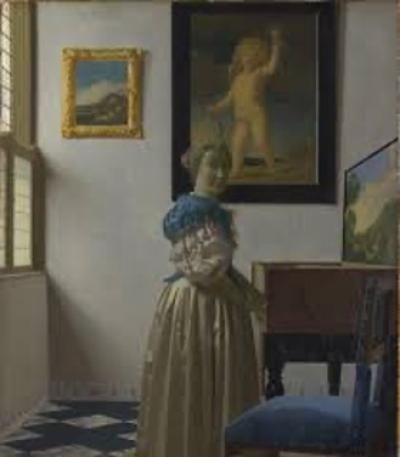
"Young Woman Standing at a Virginal" (c. 1670-1672):
A woman gazes directly at the viewer from behind her instrument, painted with Vermeer's late-period clarity and precision in an elegantly composed interior. His mature technical mastery appears in the extraordinary rendering of light on multiple surfaces - from the woman's satin dress to the gleaming virginal and the subtly rendered landscape painting above - while the careful composition suggests themes of harmony between love and music common in Dutch genre paintings.
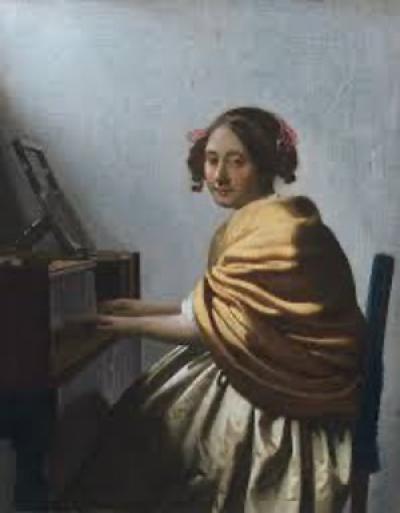
"Young Woman Seated at a Virginal" (c. 1670-1672)
In this late work, a woman sits at her instrument in an intimate domestic scene that demonstrates the refined simplicity of Vermeer's mature style. His mastery shows in the extraordinary treatment of light across varied surfaces - from the woman's silk dress to the subtle reflection in the mirror and the delicate handling of the background painting of Cupid - while the composition's careful balance of elements creates a meditation on solitude and music.
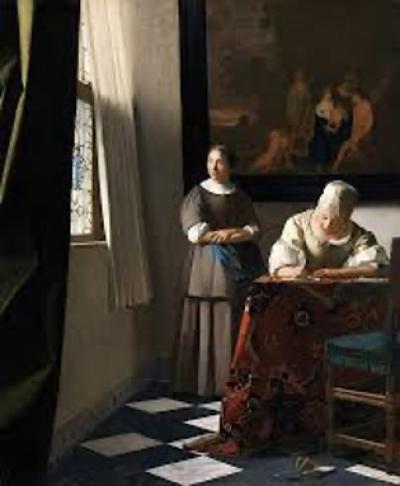
"A Woman Writing a Letter, with her Maid" (c. 1670-1672):
Set in a wealthy Dutch interior, this painting shows a lady intensely focused on writing while her maid gazes out a window, creating a masterful study in contrasting figures and psychological states. Vermeer's technical brilliance appears in multiple elements: the extraordinary fall of light across the writing table, the subtle reflection in the window, and the complex spatial arrangement suggesting both intimacy and social distance, while crumpled papers on the floor hint at the letter's emotional importance.
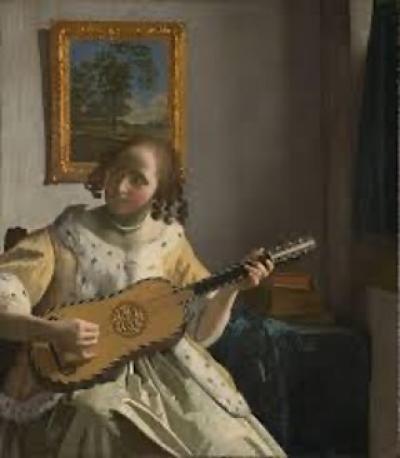
"The Guitar Player" (c. 1670-1672)
This vibrant late work shows a young woman playing guitar with unusual animation, her face turned in a joyful expression that's rare in Vermeer's typically more contemplative figures. His mature technical brilliance appears in the extraordinary handling of light on multiple surfaces - from the satin jacket to the sunlit wall - while the dynamic pose and evident movement create one of his most lively compositions.